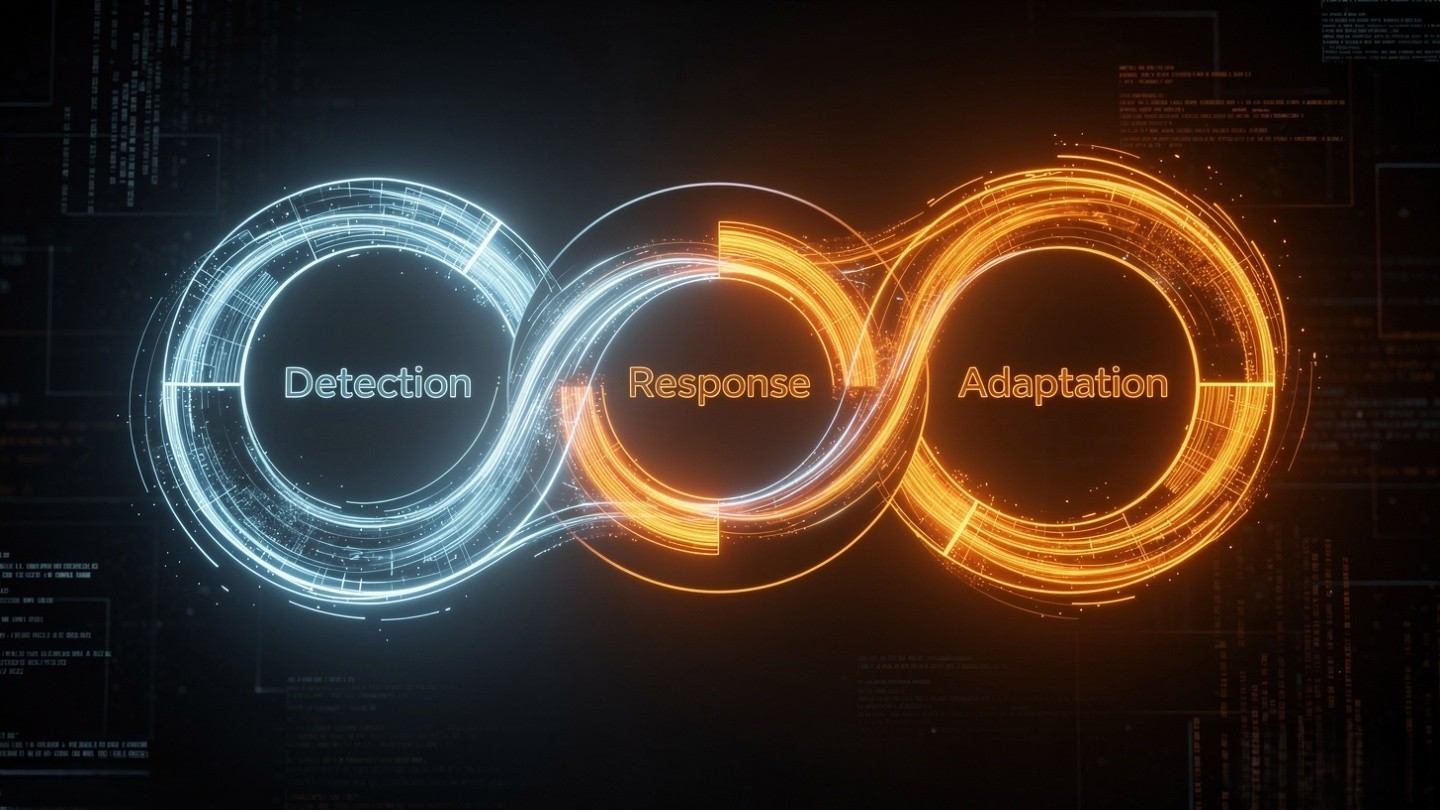


Cybersecurity is often misunderstood as a set of tools, including firewalls, antivirus software, endpoint protection systems, and monitoring dashboards. While these technologies are essential, they do not define security on their own. In reality, cybersecurity is a continuous operational cycle built on three core capabilities: detection, response, and adaptation.
Cybersecurity is often misunderstood as a set of tools, including firewalls, antivirus software, endpoint protection systems, and monitoring dashboards. While these technologies are essential, they do not define security on their own. In reality, cybersecurity is a continuous operational cycle built on three core capabilities: detection, response, and adaptation.
Organizations that focus only on prevention often discover a hard truth too late: no system is fully immune to attacks. Threats evolve, attackers adapt, and vulnerabilities emerge constantly. This is why modern cybersecurity must be understood as a lifecycle, not a static defense layer.
The organizations that succeed in securing their environments are not those that avoid all attacks but those that detect quickly, respond effectively, and adapt continuously.
Why the Traditional Security Model Falls Short
For years, cybersecurity strategies focused heavily on prevention. The assumption was simple: if you build strong enough defenses, attackers will stay out.
However, today’s threat landscape has made that approach insufficient.
Modern cyberattacks are:
Highly targeted and persistent
Automated and scalable
Designed to bypass traditional perimeter defenses
Often hidden within legitimate system activity
Even the most advanced security tools cannot guarantee complete prevention. Attackers only need one successful entry point, whether through phishing, misconfiguration, stolen credentials, or software vulnerabilities.
This shift has redefined cybersecurity priorities. Instead of asking “How do we stop every attack?”, organizations must now ask:
“How quickly can we detect it, respond to it, and adapt after it happens?”
Stage 1: Detection – Seeing the Invisible
Detection is the foundation of modern cybersecurity. Without timely detection, even the most sophisticated security infrastructure becomes ineffective.
The challenge is that modern threats are designed to remain invisible for as long as possible. Attackers often operate quietly within systems, blending into normal activity to avoid triggering alerts.
Effective detection involves more than just monitoring; it requires intelligent visibility.
Key elements of strong detection include:
Continuous monitoring of network and system activity
Behavioral analysis to identify anomalies
Threat intelligence integration to recognize known attack patterns
Early warning systems that flag suspicious activity in real time
The goal is not only to detect known threats but also to identify unusual behavior that may indicate a new or evolving attack.
Organizations that invest in strong detection capabilities gain a critical advantage: time. And in cybersecurity, time determines impact.
The earlier a threat is detected, the lower the potential damage.
Stage 2: Response – Containing the Impact
Detection alone is not enough. Once a threat is identified, the next critical phase is response.
Response refers to how quickly and effectively an organization can contain and mitigate a security incident.
A delayed or uncoordinated response can turn a minor breach into a major crisis. On the other hand, a structured response can significantly reduce damage, downtime, and recovery costs.
Effective response capabilities include:
Clear incident response procedures
Defined roles and responsibilities across teams
Rapid isolation of affected systems
Communication protocols for internal and external stakeholders
Evidence preservation for investigation and compliance
The key objective during response is containment, preventing the threat from spreading further across systems or networks.
However, the response is not just technical. It is also operational and organizational. Teams must be trained to act decisively under pressure, often with incomplete information.
Organizations that practice incident response through simulations and drills are significantly more effective during real-world attacks.
Stage 3: Adaptation – Learning and Evolving
Many organizations stop their security efforts once an incident is resolved. However, the most important stage of the cybersecurity lifecycle begins after the incident: adaptation.
Adaptation is the process of learning from security events and strengthening defenses to prevent recurrence.
Without adaptation, organizations remain vulnerable to repeat attacks. The same weaknesses that were exploited once can be targeted again if they are not addressed.
Adaptation involves:
Post-incident analysis to understand root causes
Updating security policies and controls
Strengthening detection mechanisms based on observed attack patterns
Improving employee awareness and training programs
Enhancing system configurations and patch management processes
This stage transforms incidents into learning opportunities.
In a rapidly evolving threat landscape, adaptation is what ensures long-term resilience. It allows organizations to evolve at the same pace or faster than attackers.
The Security Lifecycle in Action
When combined, detection, response, and adaptation form a continuous security lifecycle.
Detection identifies threats early
Response contains and minimizes damage
Adaptation strengthens defenses for the future
This cycle is not linear; it is ongoing. Each stage feeds into the next, creating a continuous improvement loop.
Organizations that embrace this model shift from reactive defense to proactive resilience.
Instead of focusing only on prevention, they build the ability to survive, recover, and improve after every incident.
Why This Lifecycle Matters Today
The importance of this security lifecycle has grown as cyber threats become more advanced and persistent.
Key reasons include:
1. Faster Attack Execution
Modern attacks can move from initial access to full system compromise in minutes or hours.
2. Increased Complexity of IT Environments
Cloud systems, remote work, and third-party integrations expand the attack surface significantly.
3. Human Factor Risks
Phishing, social engineering, and credential theft continue to bypass technical defenses.
4. Regulatory and Business Pressure
Organizations are expected to not only prevent breaches but also demonstrate rapid detection and response capabilities.
In this environment, traditional security models are no longer sufficient.
Building a Lifecycle-Driven Security Strategy
To implement an effective detection, response, and adaptation model, organizations must invest in both technology and capability.
Key steps include:
Implementing real-time monitoring and analytics tools
Developing structured incident response plans
Conducting regular simulations and security drills
Establishing post-incident review processes
Training teams to recognize and respond to threats effectively
Most importantly, cybersecurity must be treated as an ongoing operational function, not a one-time implementation.
Final Thought
Cybersecurity is no longer about building perfect defenses. It is about building adaptive resilience.
Threats will continue to evolve. Attacks will continue to bypass prevention. But organizations that master detection, response, and adaptation will remain in control.
The real security lifecycle is not defined by tools; it is defined by capability.
Detect early
Respond fast
Adapt continuously
This is how modern organizations survive and thrive in a constantly changing threat landscape.
Explore More

How Data Science Can Uncover the Hidden Potential of Your Business
Data Science
Why Cybersecurity Matters More Than Ever in Today’s Digital World
Cybersecurity
Audit & Certification Preparedness in 2025: Securing Cyber Resilience
Cybersecurity

How BI Data Science-Dashboards Drive Smarter Business in 2025
Data Analytics

