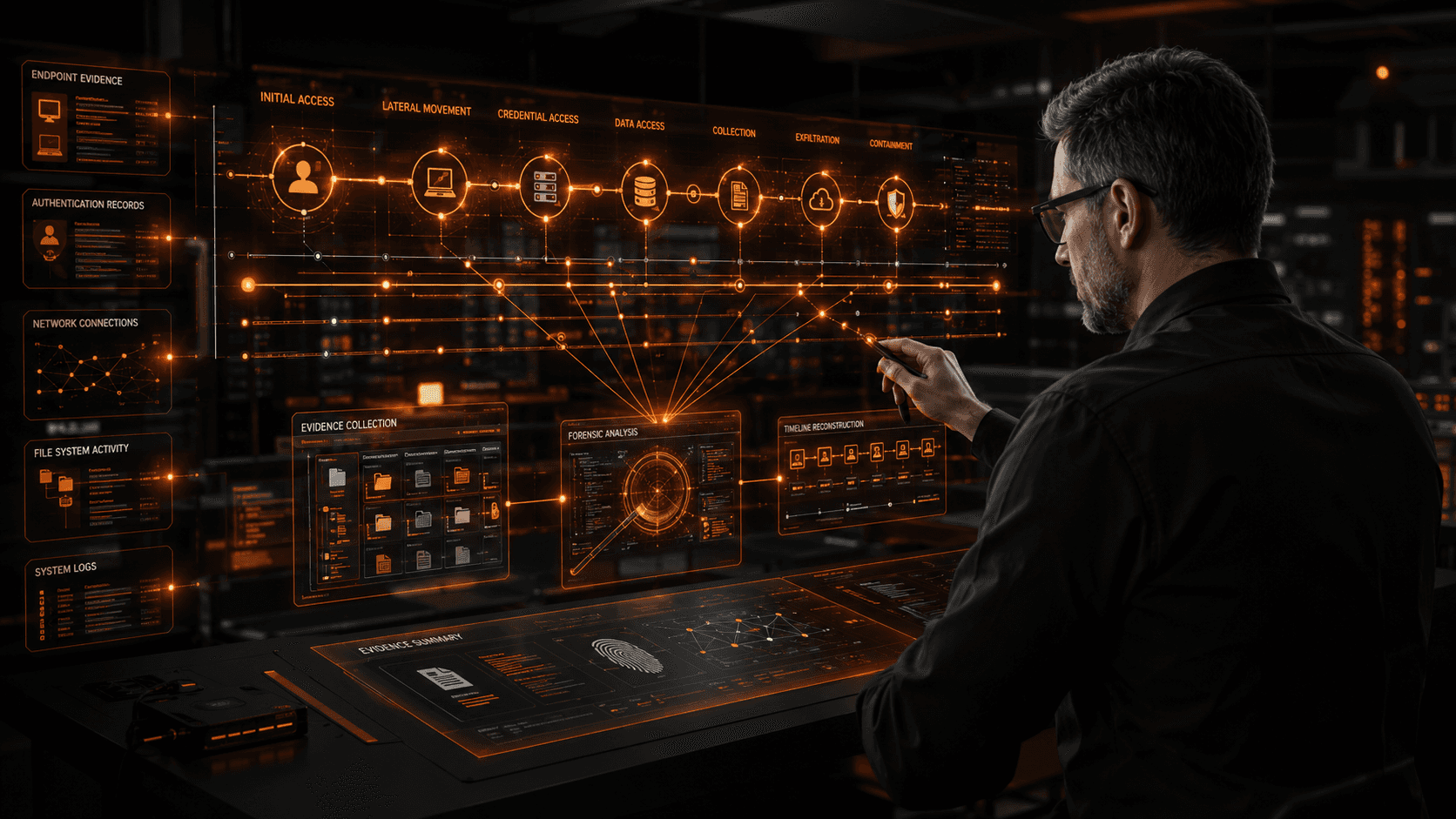


A cyber incident rarely ends when an attacker loses access or a security team contains the threat. Even after systems are restored, important questions remain.
How did the attacker enter? Which systems were affected? What information was accessed? How long did the attacker remain undetected? Did the incident involve compromised credentials, malicious software, or an insider?
The answers often exist within digital evidence.
Logs, system activity, network traffic, endpoint artifacts, authentication records, files, and other digital traces can provide valuable insight into what happened. However, finding this evidence is only the beginning. Organizations need structured processes and skilled professionals to preserve, analyze, and interpret it.
This is where Digital Forensics and Incident Response (DFIR) becomes critical.
DFIR combines forensic investigation with incident response to help organizations understand cyber incidents, contain threats, determine their scope, and support informed recovery decisions.
What Is Digital Forensics and Incident Response?
Digital Forensics and Incident Response is a cybersecurity discipline focused on investigating security incidents and responding to them in a structured manner.
Digital forensics focuses on collecting and analyzing digital evidence. Incident response focuses on identifying, containing, and managing security incidents.
Together, they provide a more complete view of a cyber event.
DFIR can help organizations:
Analyze digital evidence
Reconstruct attacker activity
Identify compromised systems
Determine the scope of an incident
Understand the potential impact
Support containment and recovery
Identify opportunities for security improvement
This combination becomes especially valuable when organizations need reliable answers after a suspected breach or security incident.
Why Digital Evidence Matters
Cyber incidents can generate large amounts of digital information. Without proper analysis, important evidence can become difficult to interpret.
For example, a suspicious login may appear insignificant when viewed alone. When combined with endpoint activity, network connections, privilege changes, and file access, it may reveal a much larger attack sequence.
Digital evidence can help investigators establish:
Initial access
Persistence mechanisms
Privilege escalation
Lateral movement
Data access or exfiltration
Malware execution
Attacker timelines
This evidence-based approach reduces reliance on assumptions and helps security teams make better decisions during an investigation.
Reconstructing the Attack
One of the most important objectives of DFIR is reconstructing what happened during an incident.
Attackers may move through multiple systems before security teams detect suspicious activity. Investigators therefore need to examine evidence across different sources and establish a timeline.
A typical investigation may examine:
Endpoint Evidence
Investigators can analyze system artifacts, processes, files, registry activity, and other endpoint information to identify suspicious behavior.
Network Evidence
Network traffic and connection records can help identify communication between compromised systems and external infrastructure.
Authentication Records
Login activity can reveal unusual access patterns, compromised credentials, privilege changes, and suspicious account usage.
Application and Cloud Logs
Modern environments generate extensive application and cloud activity records. These can help investigators understand how accounts, services, and resources were accessed.
By correlating these sources, investigators can build a clearer picture of the attack lifecycle.
Identifying the Scope and Impact
Knowing that an incident occurred is not enough. Organizations must understand how far the incident reached.
A DFIR investigation can help determine:
Which systems were compromised
Which accounts were affected
What information may have been accessed
Whether attackers moved laterally
Whether persistence mechanisms remain
Whether additional systems require investigation
This information helps leadership understand the actual scope of an incident and supports appropriate response decisions.
It can also help organizations determine whether additional notification, regulatory, legal, or contractual actions may be necessary.
DFIR and Incident Response
Forensics and incident response should work together.
Incident response focuses on controlling the immediate threat. Digital forensics provides the evidence needed to understand the incident and guide subsequent actions.
A structured DFIR process may involve:
Detection → Triage → Containment → Evidence Collection → Investigation → Eradication → Recovery → Lessons Learned
Each stage contributes to a stronger response.
For example, investigators may identify compromised credentials during forensic analysis. Incident response teams can then disable those accounts, investigate related activity, and strengthen authentication controls.
This creates a feedback loop between investigation and response.
The Importance of Evidence Preservation
Digital evidence can change quickly. Systems may continue generating logs, files may be modified, and volatile information can disappear when devices are shut down.
For this reason, evidence preservation is an important part of forensic investigations.
Organizations should establish procedures for:
Evidence identification
Secure collection
Documentation
Preservation
Analysis
Reporting
Proper handling supports the reliability and integrity of investigative findings.
It can also become important when organizations need to support legal proceedings, regulatory investigations, insurance claims, or internal disciplinary processes.
DFIR Supports Long-Term Security Improvement
A DFIR investigation should not end with an incident report.
The findings can reveal weaknesses that allowed the incident to occur in the first place.
For example, an investigation may identify:
Weak authentication practices
Insufficient logging
Poor network segmentation
Outdated security controls
Excessive privileges
Detection gaps
Inadequate incident response procedures
Organizations can use these findings to strengthen their security architecture and response capabilities.
This makes DFIR more than an investigative function. It becomes an important source of security intelligence.
Building DFIR Capability with GUTS
Effective digital forensics and incident response requires technical knowledge, structured methodologies, and practical investigation skills.
GUTS supports cybersecurity professionals and organizations in developing capabilities that strengthen incident readiness and response.
DFIR-focused capability can help teams develop expertise in:
Digital evidence analysis
Incident investigation
Attack reconstruction
Incident response processes
Evidence preservation
Threat identification
Incident documentation
Recovery and lessons learned
Building these skills internally can improve an organization's ability to investigate incidents quickly and make informed response decisions.
Every cyber incident leaves evidence. The challenge is knowing where to look, how to interpret what you find, and how to turn those findings into effective action.
Digital Forensics and Incident Response provides the structured approach organizations need to analyze digital evidence, reconstruct attack activity, determine the scope of compromise, and strengthen their response.
The value of DFIR extends beyond understanding what happened. It helps organizations learn from incidents, close security gaps, improve detection capabilities, and prepare for future threats.
When an incident occurs, evidence can tell the story. The right expertise turns that evidence into answers.
Build stronger Digital Forensics and Incident Response capability with GUTS. Develop the knowledge and practical skills needed to investigate incidents, analyze evidence, and strengthen organizational cyber resilience. Learn more at guts.bh.
Explore More

How Data Science Can Uncover the Hidden Potential of Your Business
Data Science
Why Cybersecurity Matters More Than Ever in Today’s Digital World
Cybersecurity
Audit & Certification Preparedness in 2025: Securing Cyber Resilience
Cybersecurity

How BI Data Science-Dashboards Drive Smarter Business in 2025
Data Analytics

